

As a child and teen therapist, boundaries are a topic that will 100% come up with your client. Whether it’s boundaries with parents, friends, relationships, or even boundaries that come up in the therapy room, they’re bound to come up in some way.
Boundaries Always Come Up With Child and Teen Clients
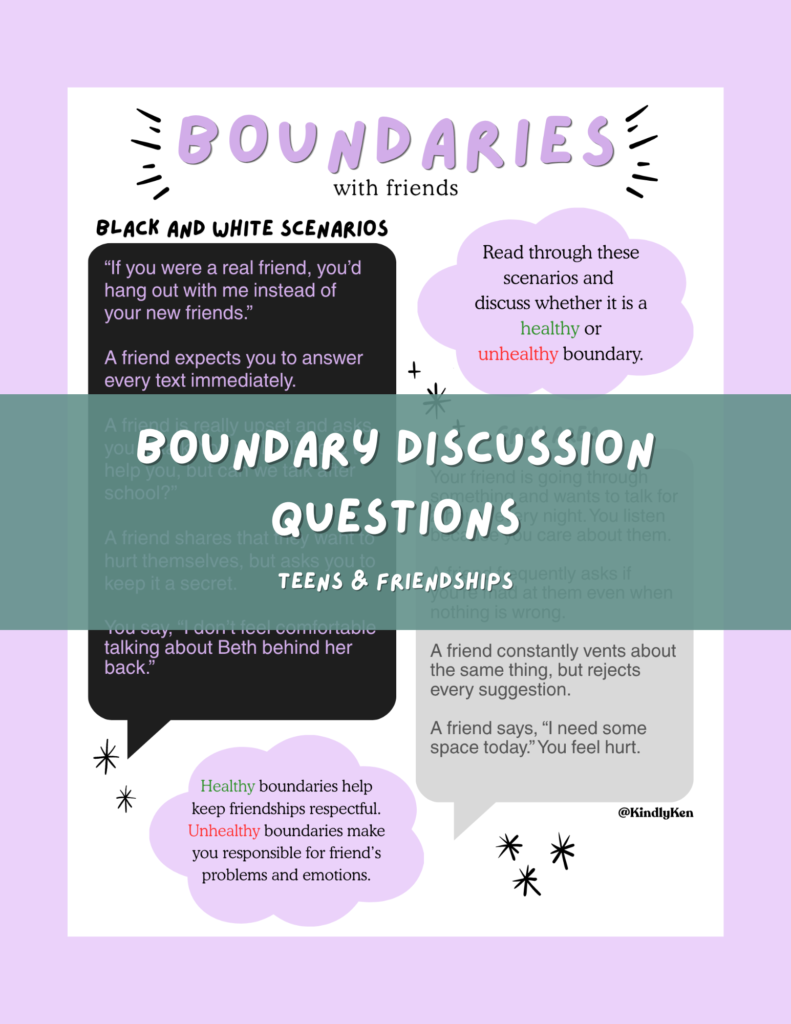
Today, I’m specifically going to focus on boundaries teens may experience in social relationships with their friends, using my handy dandy worksheet.
What This Boundary Scenarios Worksheet Does
The goal of this worksheet is to help teens identify what a healthy or unhealthy boundary may look like (or discuss ones that could be in the gray area). To be more inclusive to different learning styles, here are 3 ways you can use this worksheet with your own clients.
Adapting the Worksheet for Different Learning Styles
1. Talk It Through — For Auditory Learners
This is the most classic way to use this worksheet — just talking through it! Some kiddos may prefer to have a judgement-free discussion about the boundary scenarios. You can go through each scenario together or take turns with each one.
2. Build a Boundary Scale — For Visual Learners
Some people (like me) are more of a visual learner. If your client would prefer this style of learning, you can add a few extra materials to the activity:
- A blank piece of paper or poster board
- Scissors
- A writing utensil
Then set it up like this:
- On the blank paper, draw a boundary scale spectrum with unhealthy boundaries on one end and healthy boundaries on the other.
- Cut out each of the scenarios.
- Have your client place each one where they think it belongs on the scale.
This is a great way for your client to visualize how boundaries aren’t always so black and white.
3. Role-Play the Scenarios — For Kinesthetic Learners
The kinesthetic learning style is for the clients who learn by doing — aka roleplaying. Shoutout to the theater kids, this one’s for you! Rather than just talking about the boundary scenarios, roleplaying takes it a step further. It will make the client feel like they are actually dealing with uncomfortable social situations and needing to set a boundary (but in a controlled and safe environment, of course).
Roleplaying gives clients more practice with these situations, so they have the confidence to handle it on their own in the future.
Get a Copy of the Worksheet
If you’re also a therapist that works with teens, you can grab a copy of this worksheet here. This activity is a great way to cover the topic of boundaries and all the big feelings around them — and, as we discussed, you can adapt it in many different ways to fit your clients’ needs.